
 English
 中文简体
中文简体


Haven’t Found The Products You Want?
Enter your email...
When a factory needs to remove air from a sealed space, they often call on a device called an industrial double-stage rotary vane vacuum pump. Despite its long name, the basic idea is straightforward. This pump uses spinning vanes inside a cylinder to trap air and push it out. By adding a second stage, the pump pulls a deeper vacuum than a single‑stage version. That deeper vacuum is useful for many industrial processes, from vacuum packaging to medical equipment.
So how does an industrial double-stage rotary vane vacuum pump work? Picture a cylindrical chamber with a rotor mounted slightly off‑center. The rotor has slots that hold flat vanes. As the rotor spins, centrifugal force throws the vanes outward against the chamber wall. The space between the vanes gets larger on one side, drawing air in through the inlet. Then the space gets smaller on the other side, squeezing the air out through the exhaust. Oil is added to seal the gaps, lubricate the moving parts, and cool the pump. In a double‑stage design, the air goes through this process twice — in a low‑vacuum stage, then into a high‑vacuum stage. The result is a lower ultimate pressure, often down to a tiny fraction of atmospheric pressure.
Laboratories also use these pumps. They support vacuum ovens, evaporators, and freeze dryers. A chemistry lab might need to remove solvents under reduced pressure. An industrial double-stage rotary vane vacuum pump designed for lab use is often quieter and has a smaller footprint. Hospitals rely on similar pumps for medical suction systems and sterilizers. Even in the printing industry, vacuum pumps handle paper feeding and pressing operations.
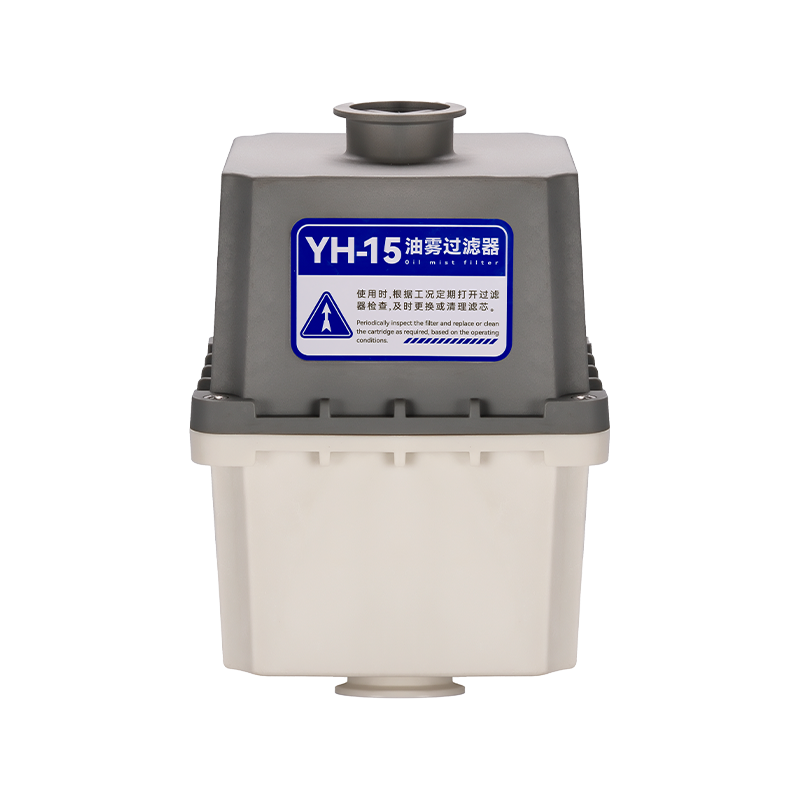
One important feature of this pump is its oil system. The oil serves as a sealant, lubricant, and coolant. Over time, the oil can collect moisture or debris, which is why many pumps have an oil mist filter or an exhaust filter. But the article does not cover maintenance, so it is enough to know that oil plays a key role. Without oil, the vanes would not seal properly, and the vacuum level would drop.
The materials used in an industrial double-stage rotary vane vacuum pump are chosen for durability. The housing is often cast iron or steel. The vanes are made of carbon or a synthetic composite that resists wear. The rotor is precision‑machined to keep tight clearances. These pumps are not fragile. They can run for long hours in dusty or warm environments as long as the oil level is checked.
Another advantage is the relatively simple design. Compared to a turbo pump or a diffusion pump, a rotary vane pump has fewer parts that can break. The vanes spin at a moderate speed, and the motor is usually an industrial‑grade induction type. This simplicity means that when something does go wrong, a trained technician can often repair it on site rather than sending it away.
However, an industrial double-stage rotary vane vacuum pump is not silent. It produces a rhythmic hum and sometimes a bit of vibration. Many factories place these pumps in a separate room or enclose them in sound‑dampening cabinets. For smaller shops, there are noise‑reduced versions with rubber mounts and insulated covers.
In summary, an industrial double-stage rotary vane vacuum pump provides a reliable way to create low pressure for many tasks. It combines two pumping stages in one unit to reach deeper vacuum levels than a single stage. From sealing a bag of chips to holding a wooden board on a router, this pump works quietly in the background. Its durable construction and straightforward operation explain why you will find it in thousands of workshops, labs, and factories around the world.

1B, Phase 1, Liandong U Valley Linhai Intelligent Industrial Park, Jiangnan Street, Linhai City, Zhejiang, China.
Xiaaoyu, Jiangnan Street, Linhai City, Zhejiang, China.
Copyright © Taizhou Yonghao Vacuum Equipment Co., Ltd.
Vacuum Pump Factory


